It’s been a while, Blog. I’ve missed you. Let’s start over.
* * *
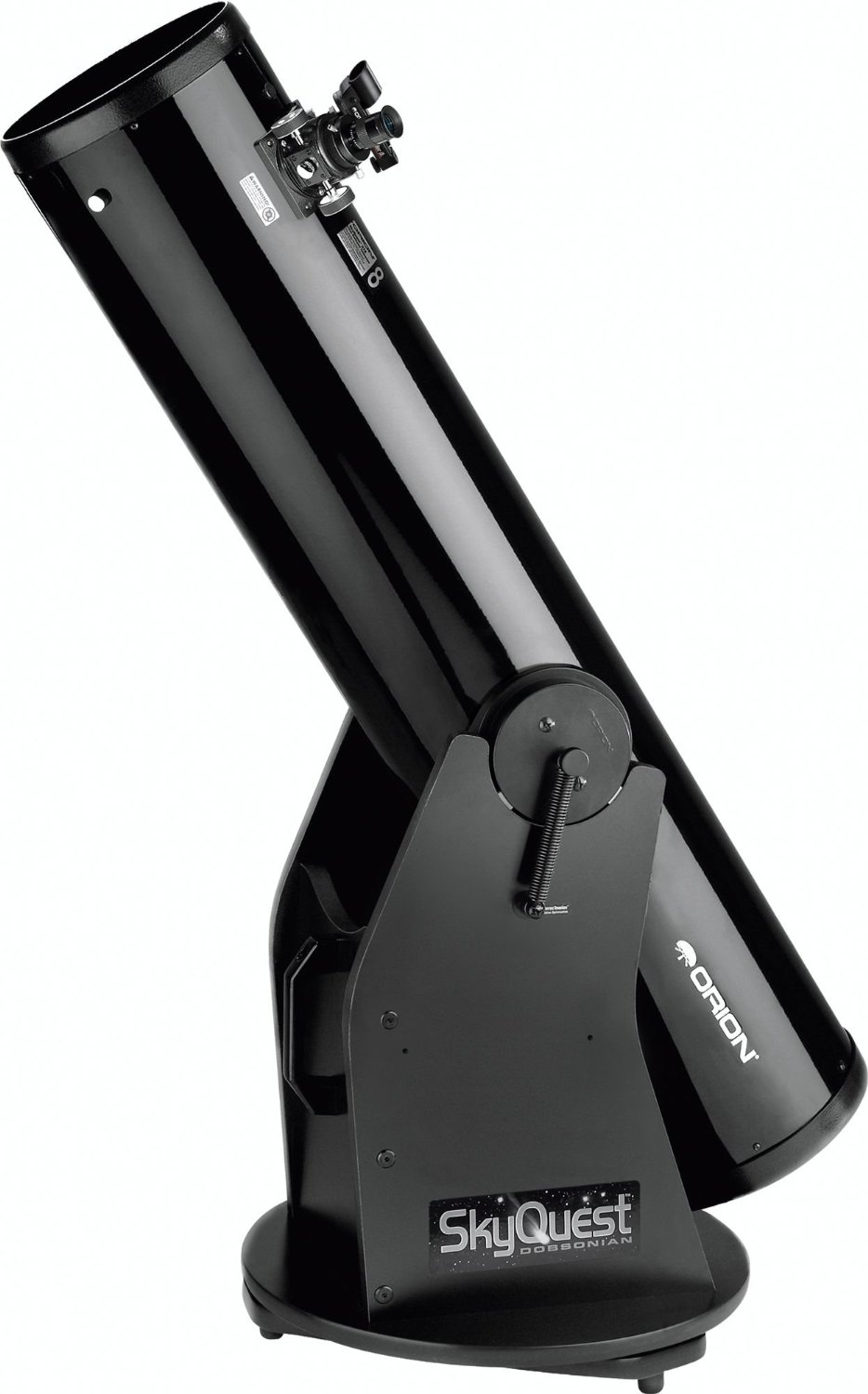
Orion Skyquest. I don’t know which serial#, but it has a 6-in reflector.
A lot has happened. I don’t know where to begin. So let’s start on what I’m currently working on. This might go in the category “shameless plug,” but I’d like to promote the other blog I begun contributing to, the PCC Engineering Club Motorized Telescope Project. I’m on a team working on a project, whose purpose is to computerize/motorize a normal Dobsonian Telescope.
At the moment, it’s just me working on the telescope project. Everyone else has either lost interest, got busy, or simply moved on. But I intend to finish this project. It’s challenging, and reintroduces concepts and ideas I learned a long time ago. Additionally, it incorporates a lot of new skills I’ve acquired in the past 2 years. Anyhow, we keep a technical blog, of which all team members are free to post on. But I’m not going to post here because what it contains can be both boring and confusing. But let’s just say that the past few months, I’ve become the sole contributor.
It wasn’t always this bad. Last summer, when we began this project, we met often and our meetings were always enthusiastic and full of energy. It was good. We made progress,however slowly. It wasn’t until the Fall 2014 semester began that people started getting busy with their classes and studies. Our weekly meetings saw fewer and fewer people. Originally we started with around 9 people. On average a person would become ‘inactive’ every other week. At some point during Fall Semester I realized it was just going to be me, no matter how good their intentions.
For now, we describe the telescope:
 - It's a 6-inch dobsonian telescope. It is very simple and easy to use. I do not know the magnification, but when looking at the moon, you can clearly see the major craters.
 - We use 12v DC geared motors to operate the azimuth and altitude axes
 - We're also using 100-tooth worm gears to in addition to the motor gearboxes, so you could say our combined gear ratio is 1:13125
 - Btw, we're using 3D printed plastic gears for now.
 - We're managing the motors and sensors with an Arduino Uno, and we're going to use a Raspberry Pi to do plate-solving, in addition to providing the user interface
Is this sufficient? Yes, I think so. Will we complete this project by the end of the Spring Semester? I hope so. I’ve recruited someone to help me code. I’ve also recruited another guy to help with the plate-solving. I’ve completed a majority of the mechanical work, all of the electronics, and I’m also spearheading the coding. It wasn’t easy, and there have been many bugs and issues I’ve had to overcome. I’ve been doing it all “nearly” from scratch. There has been help from the interwebs, but no more than the hints I need to keep moving. I cannot afford to leave this project unfinished.
Well, this might be everything I’ll ever say about the telescope project. The next time you hear about it will be when I finish it, I hope. In the mean time, I’ll post about other things.
-david
 dharbott